
Staff Feature: Ruiping Luo
May 18, 2026
- •
- •
- •
Wildlands Advocate article by Jill Girgulis, AWA Communications and Outreach Specialist
Read the PDF version here.
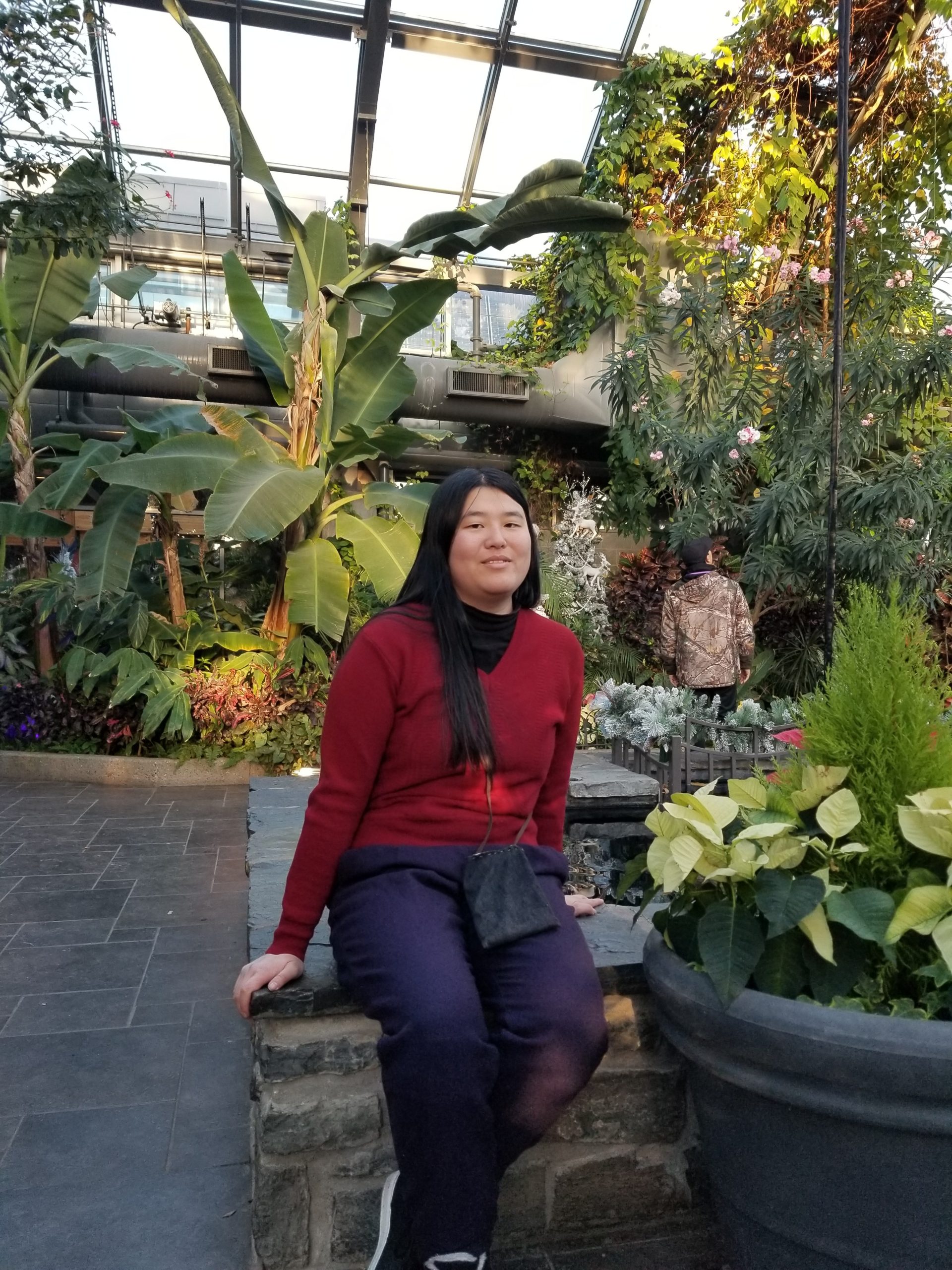
This year marks Conservation Specialist Ruiping Luo’s fifth one with Alberta Wilderness Association (AWA), an exciting milestone for AWA’s longest-serving current staff member. While she was familiar with AWA prior to getting hired back in 2021, Ruiping admits it was a relatively short acquaintance.
“I started volunteering with AWA because I was looking for organizations that were related to my field and trying to figure out what I was doing next and finish my master’s and just trying to get into the field,” she explains. Ruiping earned her Bachelor of Science in Ecology from the University of Calgary before going on to complete her Master of Science in Ecology and Evolutionary Biology at the University of Toronto.
Newly graduated, Ruiping connected with AWA in the summer of 2021, which happened to be shortly after the Alberta government had begun charging the public for the Kananaskis Conservation Pass.
“I reached out and said, ‘You know, I’m just interested in learning a bit.’ And I got a reply back that was, ‘Okay, we’re doing this survey in Bragg Creek — would you be interested in coming out?’”
The survey in question was soliciting public opinion on the aforementioned Kananaskis Conservation Pass, which had just been implemented in June.
“We did a survey just asking people what they thought about the pass. What did they do in Kananaskis? Do they think this is worthwhile, the way the money’s being spent? Things like that.”
Through this experience, Ruiping connected with Christyann Olson, at the time a Senior Consultant with AWA (a transitional role after she’d spent 21 years as AWA’s Executive Director). An official job offer followed shortly thereafter, in October 2021.
Since she, along with other staff, was hired during the COVID-19 pandemic, Ruiping’s early years at AWA were largely work-from-home, a configuration that meant staff were often “kind of doing [their] own thing.”
Nowadays, Ruiping feels AWA is a lot more integrated. “There’s more overlap [now] between files instead of everyone focusing on one issue.”
Another difference between then and now is the nature of AWA’s work. “When I started, we weren’t dealing with very reactive projects every time… [It] was much more of a ‘we want to get this area protected’ kind of project instead of ‘here’s what the government said, here’s how we’re responding.’”
As she explains, now “it’s less about pushing what we want to see out and more about trying to defend against what [the government] has changed… There’s quite a bit that’s changed, and I think AWA is a very adaptable organization.”
Speaking of adaptability, Ruiping, like all AWA’s conservation specialists, has several areas of focus. At the moment, her two largest files are grasslands, which she’s worked on since starting at AWA, and wildlife management (principally hunting and trapping), a more recent file acquisition for her.
“More people are aware of the prairies than when I started and no one really knew what they were or why they were important,” Ruiping says of the grasslands file. “I think it’s still a minority that cares about that, but a lot of it is still trying to find land owners who are willing to work with us; it’s still trying to make connections.”
Over the years of working on this file, Ruiping admits she’s “grown fond of the prairies. It wasn’t a particular interest, I think, before I really started working on it. The more I learn about the prairies, the more I’m like, wow, this is a fascinating place. It’s really cool. There’s a lot going on here — I want to learn more, and I want to protect it.”
Comparatively, the wildlife management file, which Ruiping only picked up following the departure of a colleague in 2024, has proven to be a particularly busy one.
“It’s very different to how we handle prairie work,” says Ruiping. “It just escalated really quickly.”
The escalation she’s referring to includes various hunting and trapping regulatory changes made in the past 18 months by the province’s Minister of Forestry and Parks, changes that put several threatened species at even greater risk and are not backed by science.
When tackling the wildlife management file (any of her files, really), Ruiping says she enjoys “the more analytical side… I like finding the information, analyzing it, saying, okay, what story does this tell us? Is this the same story that the government is showing us? And often it isn’t — recently at least, it hasn’t been.”
Ruiping prefers taking a science-based approach to environmental advocacy: “I was trained as a scientist. I still very much fall back on that.”
Another approach she appreciates is the slow and steady, under-the-radar one. This strategy is particularly well-utilized by the program MULTISAR, which Ruiping mentions when asked about conservation success stories. MULTISAR, as per the website, is a program dedicated to “partnering with landowners to conserve grassland species at risk in Alberta.”
“I really admire what MULTISAR is doing… They’re working with landowners, and it’s a lot more subtle. It’s not something that really makes the news,” says Ruiping. “But they’re slowly expanding so they’re protecting more areas. They’re getting more landowners aware of how to deal with species at risk and what they can do that doesn’t harm their operations and those kinds of collaborations.”
This program has been “a slow spread of information. It’s networking and collaborations that I think have been more successful in a lot of ways than the bigger issues which tend to go back and forth… You don’t make as much progress that way.”
Ruiping explains how the program is “a lot more of a small change, but it’s very on-land focused, it’s very collaborative, and it’s slowly growing. So I think that might be what we need, to be honest.”
For Ruiping, it’s no surprise that working in environmental conservation also translates to an interest in spending time out in Wild Alberta.
While she loves exploring, and would like to one day make her way up north (“I’ve never actually been north of Edmonton — I’ve never seen half the province,” she admits), Ruiping’s favourite place to visit in Wild Alberta is actually right here in town: northwest Calgary’s Nose Hill Park.
“I like it just because it’s somewhere close to me and it’s somewhere that I’m familiar with,” Ruiping says of Nose Hill. “It’s a nice, quiet place for me to just get away from things for a while… It feels like you’re outside the city.”
Of course, Ruiping does also enjoy getting out of the city for real, and she mentions Pigeon Lake as a future stop on her list.
The reason she has her eye on this location is simple: “I keep hoping to see a loon,” Ruiping, who also enjoys birding in her spare time, says of the iconic aquatic bird. “Because I keep missing the ones that are coming into Calgary. I haven’t seen one. And they don’t really come into Calgary very often.”
In general though, Ruiping would be happy to continue using her days off to uncover new aspects of our province’s numerous and varied wild spaces.
“There’s a lot of places in Alberta I still want to see.”
This interview has been edited for clarity and brevity.