

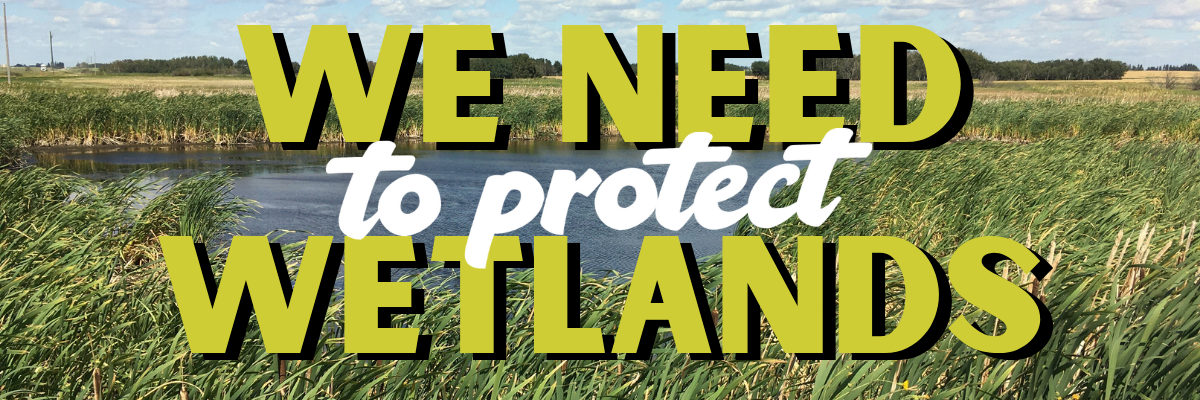
Join us in letting Alberta know that all classes of wetlands are vital and deserve protection.
HOW: A phone call blitz to the Alberta government
WHEN: Friday, Oct. 23, 2026
WHY: The government has decided some types of wetlands are expendable. We must get LOUD and demand stronger protections, making it clear that the public values all types of wetlands and the benefits they provide.
WHAT’S THE PLAN?
On this Day of Action, we need you to:
- Call your MLA (Their number can be found by inputting your postal code here: Members of the Legislative Assembly)
- Call Grant Hunter, the Minister of Environment and Protected Areas: (780)-427-2391
- Call any other government official you want
- Encourage everyone and anyone who might be interested to do the same
WHAT SHOULD YOU SAY?
- All types of wetlands are important to the health and resiliency of Alberta’s watersheds.
- Alberta must halt undertaking any changes that would weaken the Wetland Policy.
- Alberta must do more to retain wetlands and reverse loss in the province.
- (See detailed suggestions on what to say and why below)
HOW CAN YOU HELP?
- Sign up to participate, so we can track which government officials were contacted and how many times.
- Follow up your call using our letter template to ensure the province gets the message.
- Share with friends and family.
- Document and report any wetland disturbance or destruction you see.
This form is to help us track which government officials were contacted during our phone call blitz on Oct. 23, 2026.WETLANDS NEED YOU TO BE THEIR VOICE
HOW DOES THIS HELP?
Calling puts folks’ concerns on the record; a paper-trail of evidence that the public spoke up.
WHY JUST ONE DAY?
By concentrating this action on one day, it builds critical mass, keeping their phone lines busy and demanding they expend time and energy focused on this issue.
Ask your government representatives to commit to the following points:
| Point | Reasoning |
| All types of wetlands, including ephemeral, seasonal, and temporary ones, are important to the health and resiliency of Alberta’s watersheds.
|
Particularly in the prairies and Alberta’s agricultural regions, these types of wetlands are a main and key source of water in an otherwise dry, windy, and temperature-extreme climate. They contribute base flows to streams, reduce peak flows during floods, facilitate exchange between groundwater and surface water stores, increase habitat connectivity, and support movement of wildlife. Rich in biodiversity, they also provide prime breeding and nesting habitat for waterfowl, amphibians, and other water-dependent species as they migrate across the region. They help prevent soil erosion, retain sediment, sequester carbon, and absorb, transform, and remove excess chemicals like phosphorus, nitrate, nitrite, and pesticides, many of which originate from agricultural operations. They actively regulate the water balance on Alberta’s landscape, playing a particularly dominant and direct role in setting the rate, extent, and timing of runoff and flows in the prairies. |
| Ephemeral, seasonal, and temporary wetlands deserve the same oversight and due diligence as every other class and type of wetland in the province.
|
Alberta is proposing changes that remove oversight for seasonal and temporary wetlands on agricultural landscapes (ephemeral wetlands are already not considered). The government has unilaterally decided these types of wetlands provide no value, making changes that will increase their risk of degradation and destruction. This decision was made without public consultation and goes against the best available science. |
| Alberta must halt undertaking any changes that would weaken the Wetland Policy or related regulations. The government must conduct robust and transparent public engagement to ensure all interested and impacted parties have the opportunity to inform any amendments that would affect wetland management. | The Wetland Policy was originally developed through extensive public engagement. The proposed changes represent a significant departure from the policy’s original intent, so before they come into effect, the public must be consulted. While the government may argue that the Water Availability Engagement they undertook throughout 2024 – 2025 is an appropriate surrogate, none of the engagement materials focused on wetland management. The government has indicated that the proposed changes came as a result of targeted engagement with agriculture, but as wetlands are vital parts of our collective watersheds, they must be managed in the best interest of all parties, not just one stakeholder. |
| Alberta must do more to retain and reverse wetland loss in the province. The government should publish and maintain a publicly accessible database of all wetland loss and disturbance approved by the province, including impact and replacement fees collected.
|
Around 70 percent of the wetlands in the settled areas of the province have already been lost through human use and development. The overall goal of the Wetland Policy is to combat this loss, but evidence suggests it has only worked to slow the rate. The government does not report on where or how much loss is occurring, which makes it challenging to determine where to target conservation efforts. Through the Water Act, the government can approve wetland disturbance or loss for development, which means they should have records on wetlands impacted or lost, including if developers opted to pay a replacement fee as an alternative to restoring the wetland. This information must be made publicly available to accurately monitor loss. |
| Alberta must prioritize amendments to the Wetland Policy that would strengthen protections for all classes of wetlands. The Wetland Policy must be implemented as originally intended, to facilitate the gain of wetlands in Alberta and combat the ongoing declines.
|
As written, the Wetland Policy is not a conservation policy — it does not inherently protect wetlands; it just acknowledges they have value and provides the steps that should be taken to avoid impacting them. This is why it has not served to reverse declines, only slow them. It must be strengthened to offer actual protections to wetlands, outlining specific conditions in which their destruction will not be permitted. There also must be more efforts to restore and replace wetlands where they are lost, and fewer existing loopholes to avoid doing so. |
BACKGROUND: The Alberta government estimates that around 70 percent of the wetlands in the settled areas of the province have already been lost through human use and development. This is concerning because wetlands are powerhouses on the landscape; they provide us with numerous benefits including improving water quality and mitigating the severity of floods, wildfires, and droughts.
Wetlands are diverse, and there are many different types, but all are valuable and provide benefits. Temporary wetlands appear and hold water for periods after a snowmelt or heavy rainfall, while seasonal wetlands hold water throughout most of the growing season but typically dry up by the end of summer. In the prairies, these types of wetlands are a key source of water in an otherwise dry, windy, and temperature-extreme climate.
Research finds they play a dominant and direct role in setting the rate, extent, and timing of runoff and flows in the region. Seasonal and temporary wetlands ensure Alberta has natural places to store and retain water on the landscape when it is available, which then function to slowly release it back into the watershed when conditions are dry and precipitation is limited. In a province that has already experienced considerable loss of wetlands, retaining the ones that remain is more critical.
Despite this, the Government of Alberta is proposing changes that will remove oversight for seasonal and temporary wetlands on agricultural land. Previously, before disturbing any type of wetland, you needed to get a professional assessment of its value to ensure you were not degrading or destroying particularly beneficial ones. But, under the proposed changes, the provincial government has made the blanket decision that these types of wetlands are expendable.
If the decision is allowed to stand, temporary and seasonal wetlands located on private cropland will be able to be cultivated, seeded, sprayed, ditched, drained, infilled, and otherwise negatively impacted without consideration after amendments are made to the Water (Ministerial) Regulation and Alberta Wetland Policy this fall. The government has conflated permanence with importance, and we will lose valuable, important wetlands because of this decision.
More information about wetlands can be found here: Wetlands – Alberta Wilderness Association