

Scoping out if it’s Feasible to Study the Scope and Feasibility to Feasibly Undertake a Study of the Ardley Dam’s Scope
November 25, 2026
- •
- •
- •
By Kennedy Halvorson, AWA Conservation Specialist
Read the PDF article here.
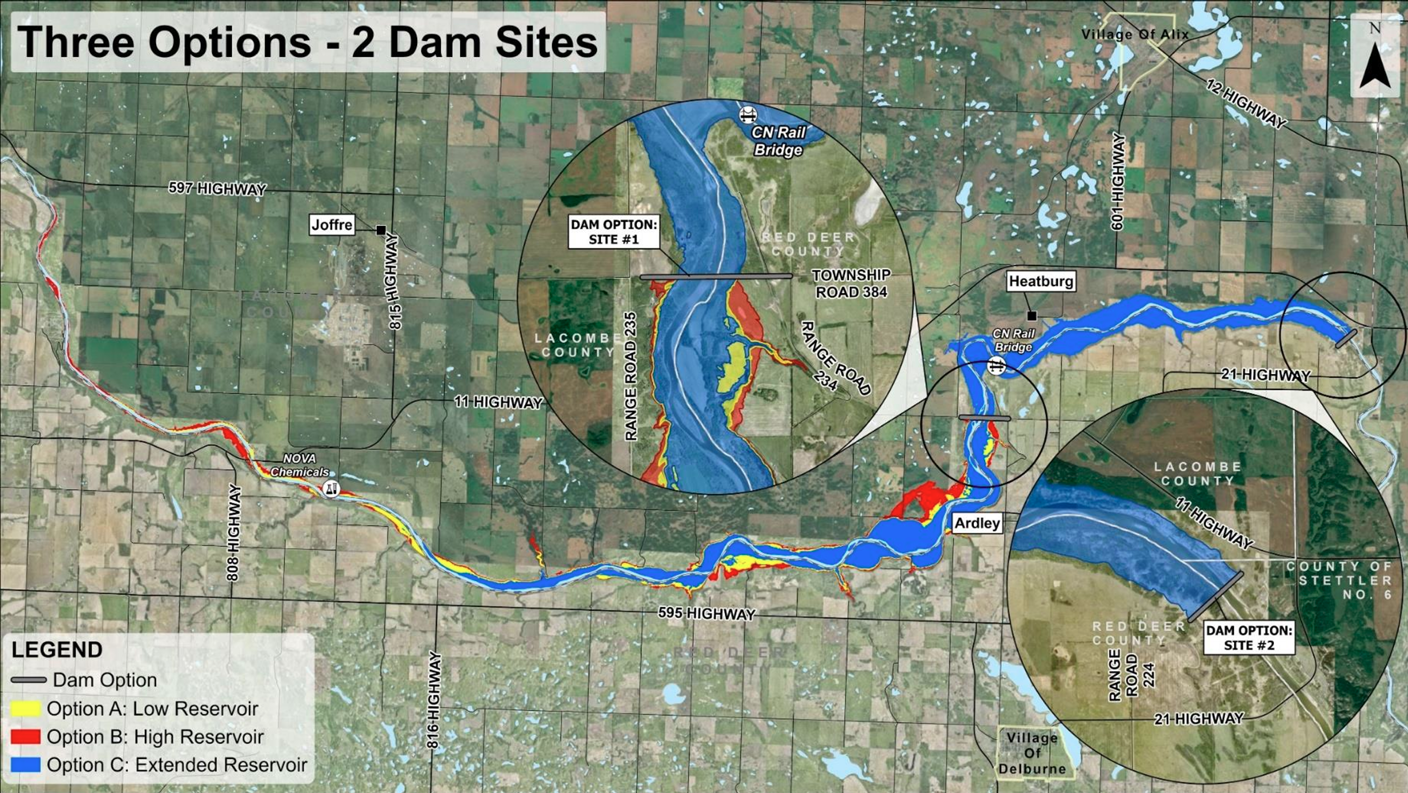
Three dam and reservoir options being investigated near Ardley. Map © EPA, Gov. of Alberta
The idea of damming the Red Deer River east of the city has been tossed around for over a century, and it’s back, back, back again in the government’s latest Ardley reservoir study engagement. It’s a confusing process, with the province “asking Albertans for feedback on the Ardley Reservoir Scoping and Feasibility Study,” a study that’s not yet available to the public. Attending an engagement session reveals what they actually want, which is for folks to provide any concerns about a potential dam and reservoir in the area, which then may or may not inform the study the government is working on.
Specifics on Ardley have been sparse: we know they’re investigating three options, ‘High,’ ‘Low,’ and ‘Extended,’ but impacts to river flows, aquatic ecosystems, local landowners, recreation interests, and even just ballpark costs are apparently still being determined, which is hard to believe. So, without providing some critical information, they want to know your thoughts! Clear as a sediment-laden reservoir bottom, right?
It’s also unclear why the Ardley Dam is even being studied again. In 2014, Stantec Consulting Ltd. completed a Flood Mitigation Study on the Red Deer River for the province, which reviewed but ultimately did not recommend Ardley because it would be “expensive to construct,” have major operational costs, and high environmental, social, and cultural impacts. They estimated that for every dollar the project costs, we get only 81 cents in beneficial returns, with a net negative of over $26 million. Stantec concluded by saying that projects like Ardley should only be considered “if it is determined that the localized flood protection measures do not provide sufficient flood mitigation.”
A year later, in 2015, WaterSMART came to similar conclusions during government-contracted work in the basin. In their Room for the River Report, it was noted that while Ardley could provide mid-stream storage for “both flood and drought mitigation,” such an option “presents fiscal and environmental trade-offs” and “can encourage more risky floodplain development and exposure to catastrophic failure.” Numerous other recommendations were supported as first measures, including reducing human footprint in the headwaters, conserving wetlands, relocating residences out of floodplains, and siting and constructing municipalities and infrastructure such that they are resilient to natural disasters.
Some quick math:
In 1968, it was estimated that the Ardley Dam and reservoir would cost $68 million to build and $4.2 million to operate annually. Adjusting for inflation, today that’s $612 million in capital costs plus $38 million a year to operate. Notably, the Oldman Dam’s final construction cost was almost three times more than what had been estimated in 1968, after controlling for inflation. If Ardley was similarly underestimated, the project is looking at building costs of over $1.8 billion.
WaterSMART’s Climate Vulnerability and Sustainable Water Management in the SSRB Project, published in the same year, modelled “four plausible basin scenarios” and management strategies for the Red Deer River. Additional storage from a dam and reservoir at the Ardley site only emerges as a strategy if there is High (Scenario 3: 525,000 dam3 allocated, 444,000 dam3 withdrawn) or Extremely High Growth (Scenario 4: 655,000 dam3 allocated, 575,000 dam3 withdrawn) in water use in the basin. Currently, cumulative allocations on the Red Deer River before it exits the province are 340,000 dam3, well below either scenario described. WaterSMART noted that “additional storage would likely only be considered once growth outstripped the ability for current storage and infrastructure to meet demands and all feasible conservation efforts had been applied.”
Undertaking another Ardley study now raises numerous questions. Is the government anticipating a large increase in water use and allocations in the Red Deer River, and if so, what for? Has Alberta exhausted all other measures and conservation tools recommended as first priorities by the consultants? And if so, have these still not been sufficient to meet current growth trajectories or provide water security and natural disaster mitigation in the Red Deer River Basin? Who knows what answers we’ll get — government staff did confirm there were no guarantees if or when findings from the Ardley reservoir engagement would be made publicly available.
Dams never die. Instead, they are scoped and studied to oblivion until a government, willing and ignorant enough, comes into power and decides it’s feasible to ram one through.